
Review · SWITZERLAND
Lucerne: Swiss Chocolate Adventure Experience
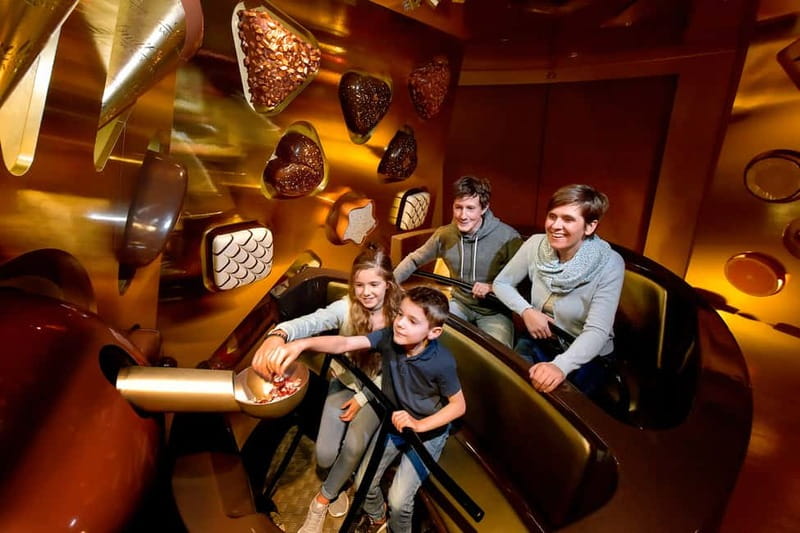
The Swiss Chocolate Adventure turns chocolate making into a 30-minute ride through 10 themed stops. You sit in a cart shaped like a chocolate piece, or cup-like vehicle according to one description, and roll past displays about cocoa beans, Swiss production, transport, and confectionery. Audio commentary fills in the story while aromas and chocolate flavors add a sensory touch.
I like the simple format: you get a clear introduction to chocolate’s origins and a free Swiss chocolate sample without committing half a day. I also like that the ride fits neatly into a visit to the Swiss Museum of Transport. The drawback is that you remain seated and mostly watch and listen, so anyone hoping for a hands-on factory visit may find the experience too passive for the price.
Key points to know before booking
- Ten stops cover the full chocolate story: From cocoa cultivation in Africa to Swiss production and retail.
- The ride lasts about 30 minutes: It works well as a short indoor activity between other Lucerne sights.
- Audio commentary is widely available: Listed choices include English, French, German, Italian, Korean, Portuguese, Spanish, and Traditional Chinese.
- You get a chocolate sample: It can be enjoyed during the visit or taken home.
- The attraction is inside the Swiss Museum of Transport: You arrange your own transportation to the museum.
- The experience is seated and passive: It uses moving carts, displays, narration, aromas, and flavors rather than active demonstrations.
Entering the Swiss Chocolate Adventure in Lucerne
The Swiss Chocolate Adventure is located inside the Swiss Museum of Transport, one of Lucerne’s major indoor attractions. That setting matters. You do not need to make a separate trip across town for a brief chocolate stop, and you can pair the ride with the museum if you have more time.
Your admission gives you access to the chocolate attraction itself. Food, drinks, and transportation to the museum are not included, so plan this as one part of your Lucerne sightseeing rather than a complete day out.
The host language is German, but the audio guide offers a wide list of alternatives. English, French, German, Italian, Korean, Portuguese, Spanish, and Traditional Chinese are listed among the choices. If you need commentary in a language other than German, confirm the available option when you enter.
The experience is wheelchair accessible. That makes the seated ride a practical choice for visitors who want a short indoor activity without a long walking route.
More Chocolate Tours around Switzerland:
- Lindt Home of Chocolate Museum Entry Ticket
★ 4.7 · 9,329 reviews - Zurich: City Tour, Cruise, and Lindt Home of Chocolate Visit
★ 4.5 · 4,624 reviews - Award-Winning Geneva Chocolate &Old Town Tour with Boat Ride (3h)
★ 5.0 · 3,721 reviews
What happens during the chocolate-themed ride
You take a seat in a moving cart designed to resemble a chocolate cube. Another description compares it to a cup, so the exact shape may not be quite as literal as the title suggests. Either way, the cart is the central feature of the attraction, and you stay seated as it moves from display to display.
The ride uses recorded commentary, visuals, scents, flavors, and sets to explain how chocolate reaches the shop counter. You are not walking through a working chocolate factory, and you are not making pralines yourself. Think of it as a museum presentation with a slow-moving ride system.
The route is divided into about 10 stops. The displays follow chocolate from its beginnings to its finished form, so the experience has a clear order rather than a collection of unrelated facts.
The format is particularly easy for families. You sit back, listen, and watch while the cart does the moving. The trade-off is equally clear: you have little control over the pace and limited opportunity to interact with the displays.
Stop one: discovering where chocolate began
The opening part introduces the origins of chocolate and the discovery of cocoa. The focus is not only on the finished Swiss bar, but on the raw material that makes it possible.
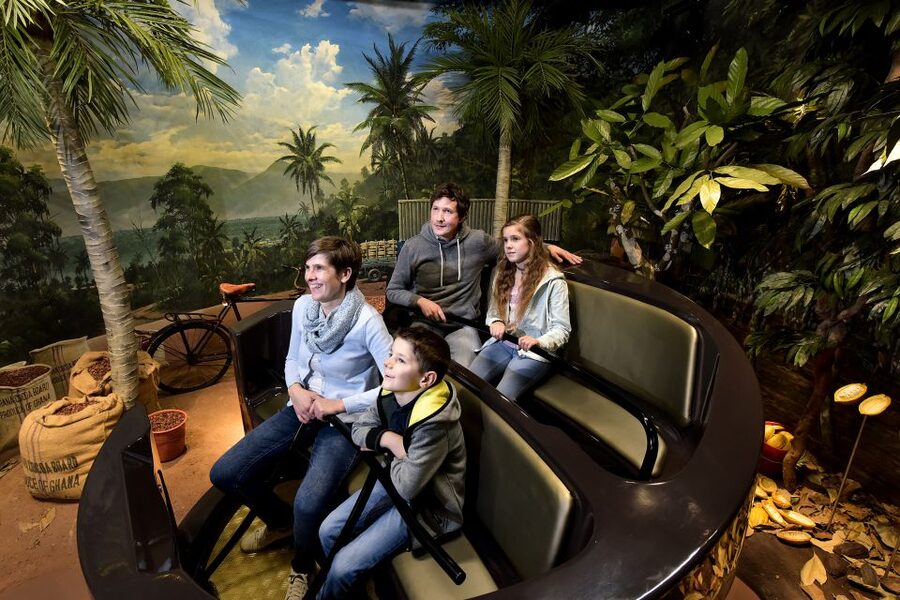
You learn when and how chocolate was discovered, then move toward the story of cocoa beans. The attraction connects this early history with the places where cocoa grows, including Africa and the tropical regions associated with cocoa cultivation.
This section gives children a useful starting point because it shows that chocolate does not begin in a wrapper. It begins as a crop, with a long journey before it becomes a sweet treat.
For adults who already know the basic story, the information may feel familiar. The ride is designed as a broad introduction, not a specialist lecture on cocoa botany, colonial trade, or food science.
Stop two: cocoa cultivation and the work behind the bean
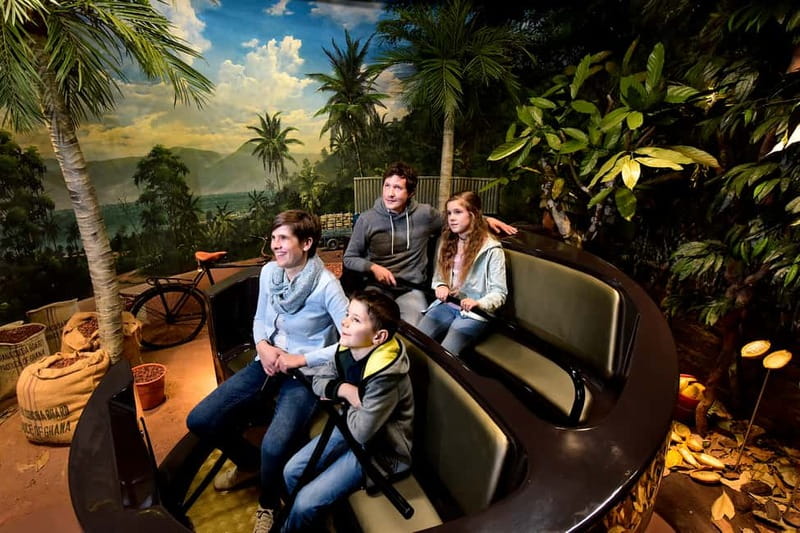
The next part looks at cultivation. You learn how people grow the valuable cocoa beans and why the raw ingredient must travel from warm growing regions to chocolate-making centers such as Switzerland.
The attraction’s strength here is its simple connection between agriculture and confectionery. You see chocolate as a product that depends on farming, transport, processing, and skilled manufacturing.
The presentation does not appear to be a long, detailed treatment of every stage of cocoa farming. If you want a very technical account of harvesting or farming conditions, this short ride may leave you wanting more. Still, it gives you the basic chain in a way that is easy to follow.
The sensory effects begin to matter at this point. Aromas and visual displays help break up the spoken explanation. You are not simply reading panels in a quiet gallery, which gives the ride more character than a standard display.
Same cocoa, a different bite:
- Zurich Sights: Cruise, Lindt Chocolate and optional FIFA Ticket
★ 4.0 · 1,028 reviews - Chocolate Flavors Walking Tour of Geneva
★ 4.9 · 670 reviews - Zurich: Lindt Home of Chocolate Guided Tour & Entry Ticket
★ 4.8 · 477 reviews - Maison Cailler chocolate factory Visit
★ 4.5 · 339 reviews
Stop three: transporting cocoa to Switzerland
After the cultivation story, the route follows cocoa as it is transported. This part explains how the beans move from their growing regions toward production centers and, eventually, stores.
Transport is easy to overlook when you think about chocolate. A bar seems small and simple once it reaches a shop, but the ride reminds you that its ingredients and finished products travel through several stages.
This stop also helps explain the attraction’s Swiss focus. Switzerland is presented as the place where cocoa becomes the smooth, finished chocolate associated with the country’s confectionery tradition.
Do not expect a full logistics exhibit with extensive maps or shipping statistics. The presentation is intended to keep moving, and the information is delivered in short sections as the cart carries you forward.
Stop four: from cocoa bean to chocolate
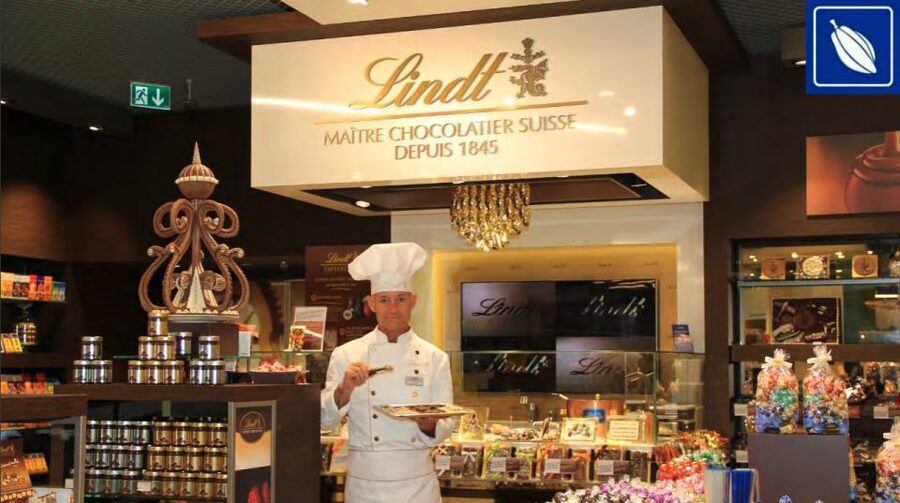
The middle section turns to production. Here you learn how cocoa beans are transformed into chocolate, moving from raw agricultural product to the mixture used in bars, pralines, and other sweets.
The experience uses multimedia displays rather than a live production floor. You may see and hear the process explained, but you will not be standing beside operating machines or watching staff temper chocolate in front of you.
That distinction is important when considering the $23 price. The admission pays for a themed museum ride with audio and sensory effects. It does not provide a factory tour, a cooking lesson, or a large tasting session.
I find this part most useful for first-time visitors to a chocolate attraction. It gives you a basic understanding of what happens between the cocoa bean and the finished product without requiring technical background.
Stop five: Swiss chocolate and the finished product
The Swiss section explains how chocolate is manufactured in Switzerland and why Swiss chocolate has such a strong reputation around the world. The emphasis is on production and quality rather than on a specific working brand or named chocolatier.
You get a general picture of how Swiss chocolate is made and prepared for sale. The attraction also shows how the product moves from the manufacturing stage toward confectionery counters.
The main benefit is context. After hearing about cocoa farming and transport, you see why Swiss chocolate is not simply a local crop. Switzerland takes ingredients from far away and turns them into a finished product identified with the country.
Some adults may find the facts too familiar. The attraction covers information many people already know, and it does not promise rare industry secrets. Families and casual visitors will likely get more from the straightforward storytelling than chocolate specialists will.
Stop six: aromas, flavors, and the sensory parts
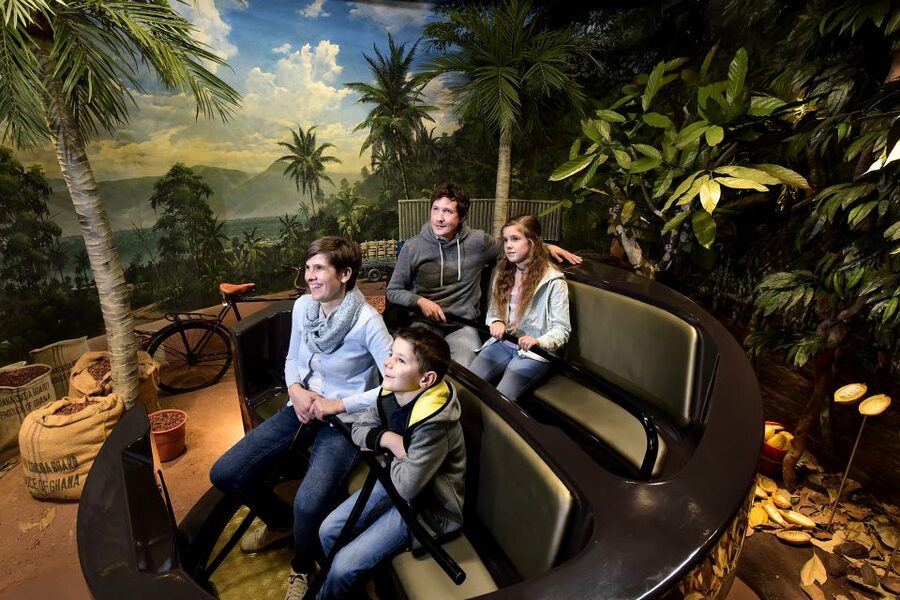
The ride is designed to involve more than sight and sound. Aromas, flavors, and chocolate-related visual effects appear along the route, giving you a stronger sense of the subject than a conventional audio tour.
This is where the experience feels most playful. You are not merely sitting in a dark room listening to a lecture. The attraction tries to connect the information with the smell and taste of chocolate.
The sensory effects are still part of a controlled museum presentation. They do not turn the ride into a full tasting workshop. You should expect brief touches of aroma and flavor, not a table covered with different cocoa origins or a guided comparison of pralines.
At the end, you receive a chocolate sample. It is a small but welcome extra, and you can eat it during the visit or save it for later. The sample does not transform the value of the ticket, but it gives the experience a pleasant finish.
Stop seven: how chocolate reaches the shop
The later displays follow chocolate through packaging, transport, and sale. This brings the story back to everyday life, because the final destination is the confectionery counter where you buy the product.
The route helps you connect the stages: cocoa is cultivated, beans are moved, chocolate is produced, and finished sweets are sent to shops. That broad view is one of the better reasons to choose this attraction over a simple tasting.
The trade-off is that you remain an observer. There is no indication of a workshop where you decorate a bar, grind beans, or prepare a praline. If active participation is central to your idea of a chocolate experience, look carefully at the format before booking.
The ride format: charming for some, limited for others
The moving cart is a smart choice for a short museum attraction. It keeps the group moving, gives children something to look forward to, and lets you cover 10 sections without a great deal of walking.
It also limits the experience. You cannot stop to study a display for as long as you like, and you have no control over the route. The audio guide carries much of the explanation, so the quality of your experience depends partly on how much you enjoy listening while the cart moves.
A critical point from the available feedback is that one cart reportedly broke during a visit. That appears to have been an isolated problem rather than a stated feature of the attraction, but it is worth keeping expectations realistic with any mechanical ride.
The strongest praise is brief and enthusiastic. Some people find it simply fun and enjoyable, especially as a short stop. The lower assessment focuses on value: the ride can feel too passive, the facts can seem familiar, and the full production chain may not feel as exciting as expected.
Both reactions make sense. This is a polished introduction, not a behind-the-scenes factory tour.
Is $23 a fair price for 30 minutes?
At $23 per person, this is not a bargain if you judge it only by time. Thirty minutes passes quickly, and the sample is small. You are paying for the set design, moving ride, audio presentation, and sensory effects as much as for the chocolate itself.
The value improves if you are already visiting the Swiss Museum of Transport. You can add a focused chocolate experience without setting aside a separate morning or afternoon, and the indoor format is useful when you want a break from outdoor sightseeing.
For children, the cart and changing displays may justify the cost more easily. For adults who already know how cocoa becomes chocolate, the price may feel high unless you particularly enjoy themed museum attractions.
I would not book it expecting unlimited tasting or direct access to a chocolate factory. I would book it as a compact, family-friendly explanation of the complete chocolate journey, with a little scent, flavor, and Swiss flair.
Timing, language, and practical details
The activity lasts 30 minutes, but you need to allow additional time to reach the Swiss Museum of Transport and enter the attraction. Starting times vary, so check availability for the date you want.
You arrange your own transportation to and from the museum. The ticket includes the Swiss Chocolate Adventure entrance, the audio guide, and the sample, but not food or drinks beyond what is specifically provided as part of the experience.
The host or greeter speaks German. Audio options are listed in English, French, German, Italian, Korean, Portuguese, Spanish, and Traditional Chinese. This makes the attraction easier to follow for international visitors, although the live welcome may still be in German.
The attraction is wheelchair accessible. You can also cancel up to 24 hours before the activity for a full refund, and the reserve-now, pay-later option can help if your Lucerne plans are still shifting.
Who will enjoy this most?
I would recommend the ride to families who want a short indoor activity with a clear theme. Children may enjoy the vehicle, the movement between displays, the smells, and the chocolate sample even if they do not follow every historical detail.
It also suits visitors who want a gentle introduction to Swiss chocolate but do not have time for a longer factory visit. The 30-minute length makes it easy to fit around other museum or city plans.
Chocolate enthusiasts should think twice. If you want serious tasting notes, detailed production machinery, or hands-on confectionery work, this attraction may not go far enough.
It is also less suitable for anyone who dislikes passive presentations. The ride does not offer much interaction, and the commentary covers familiar basics. The attraction works best when you accept it as a short multimedia show rather than a practical workshop.
Should you book the Swiss Chocolate Adventure?
Book it if you want a short, accessible introduction to Swiss chocolate and you are already planning to visit the Swiss Museum of Transport. The 10-stop route gives you a tidy account of cocoa origins, farming, transport, Swiss production, and retail, while the aromas, flavors, and sample keep the subject from feeling completely static.
Skip it if $23 feels steep for 30 minutes or if you expect to tour a working chocolate factory. The ride is seated, the material is introductory, and the experience may feel passive once the novelty of the cart wears off.
For families and casual visitors, it is a pleasant add-on. For serious chocolate fans, spend your money only if the museum setting and compact multimedia format appeal to you.
FAQ
Where does the Swiss Chocolate Adventure take place?
It takes place at the Swiss Museum of Transport in Lucerne, Switzerland.
How long does the experience last?
The experience lasts approximately 30 minutes.
What is included in the ticket?
The ticket includes entry to the Swiss Chocolate Adventure, an audio guide, and a chocolate sample.
Which languages are available for the audio guide?
The listed audio guide languages are English, French, German, Italian, Korean, Portuguese, Spanish, and Traditional Chinese.
Is the live host or greeter multilingual?
The host or greeter language is German.
Is the experience wheelchair accessible?
Yes, the activity is listed as wheelchair accessible.
Can I cancel my booking?
Yes. You can cancel up to 24 hours in advance for a full refund. The activity also offers a reserve-now, pay-later option.
Freshly tempered around Switzerland
- Zurich Open-top Tour and Chocolate and Cheese Countryside★ 3.5 · 11 reviews
- Zurich: Chocolate Tasting and Walking Tour with a Local★ 4.2 · 13 reviews
- Lindt Chocolate Museum with Cruise Transfer from Zurich★ 4.6 · 7 reviews
- Day/Night Sledding + ALL-YOU-CAN-EAT Cheese&Chocolate Fondue★ 4.7 · 4 reviews
- Zurich Open Top Bus, Chocolate and Cheese Factory Tour Appenzell★ 3.0 · 12 reviews
- Full-Day Private Zurich Sightseeing Tour and Chocolate Tasting★ 5.0 · 5 reviews
- Zurich with Cruise and Lindt Home of Chocolate Private tour★ 4.5 · 8 reviews
- Zürich, Lindt Chocolate, Rheinfalls and Stein am Rhein★ 5.0 · 14 reviews
More Switzerland Chocolate Tours to compare.
Zurich: City Tour, Cruise, and Lindt Home of Chocolate Visit
Read our review →
Award-Winning Geneva Chocolate &Old Town Tour with Boat Ride (3h)
Read our review →
Zurich Sights: Cruise, Lindt Chocolate and optional FIFA Ticket
Read our review →
Zurich: Lindt Home of Chocolate Guided Tour & Entry Ticket
Read our review →

Zurich Food Tour with 10 Local Delicacies, Cheeses & Chocolates
Read our review →Chocolate lists with this tour